You can correct an agent’s mistake today, watch it fix the problem, and still see it make the exact same mistake tomorrow. That happens not because the model is incapable of learning from what happened, but because the next session has no access to that experience.
In production, agents need to combine live system state with knowledge built up over time. APIs and monitoring tools show what’s happening right now. Past actions, their outcomes, incidents, and human corrections explain things live state can’t, and without them a reasonable-looking action can turn into a costly mistake.
The real engineering challenge is deciding what should survive a session, keeping that knowledge accurate as things change, and bringing it back at the step where the agent needs it.
1. The Server That Got Shut Down Twice
Suppose you run an infrastructure cleanup agent called CostGuard that sweeps your staging environment (staging-cloud)
every week, shutting down idle compute instances to trim cloud spend.
Here is one week without structured runtime memory:
- Friday afternoon: The agent scans
staging-cloudand spotsgpu-bench-01, an expensive GPU instance averaging 0.2% CPU utilization over the past 72 hours. Following its standard cleanup playbook, it stops the instance. - Friday night: QA’s scheduled weekend benchmark pipeline crashes because
gpu-bench-01is offline, paging the on-call engineer. - Monday morning: After investigating the failure, you open a session with
CostGuardand tell it: “Restart gpu-bench-01. Friday’s cleanup broke our QA regression suite. Keep the instance running until QA migrates the suite to the shared Kubernetes cluster.” The agent restarts the server and confirms it is back online. - Thursday morning: You open a fresh session and prompt
CostGuard: “Run the weekly staging cost cleanup.”
The agent queries the cloud provider, lists the running instances, and checks their metrics. Once again, gpu-bench-01
shows near-zero CPU utilization since the restart. With no memory of Monday’s instruction, it treats the server like any
other idle instance and shuts it down a second time.
Two common approaches to cross-session memory both miss what matters here:
Standard RAG over chat logs misses the relevant constraint. Thursday’s prompt is “Run the weekly staging cost cleanup.”
It never mentions gpu-bench-01, QA, or regression benchmarks. If retrieval runs only once, against the user’s initial
request, Monday’s instruction has no reason to rank high enough to make the cut. The agent only learns that
gpu-bench-01 is involved after its cloud discovery tool returns mid-session.
Rolling session summaries mix stale history with live state. They can omit important details or carry forward
observations that are no longer true. Last week’s CPU metrics, or whether an instance was running several days ago,
aren’t worth remembering, because the cloud API gives live ground truth on demand. The instruction that changes how
those metrics should be read is the part worth keeping.
The agent has to remember why the instance must stay up despite looking idle, what broke the last time it was stopped,
and what condition lifts the restriction. That knowledge needs to be available right when the agent is about to act on
gpu-bench-01, even if the user never names the instance.
2. Memory Belongs to the Runtime
A common anti-pattern in agent design is giving the language model a save_memory() or search_memory() tool and
hoping it remembers to call them. Models focused on completing a task often fail to record important outcomes, and they
rarely search past sessions when they don’t know relevant history exists. Conversely, pausing the user’s session after
every tool call so another model can summarize what happened adds unnecessary latency.
A more reliable pattern moves memory orchestration out of the model’s tool belt and into the application runtime wrapping the agent loop. The runtime takes responsibility for capturing execution history, maintaining persistent knowledge, and retrieving relevant context as a task unfolds.
But memory isn’t a single store of conversation history. An operational agent needs records of what happened, knowledge that stays useful across sessions, reusable procedures, and the immediate context for its next decision. That gives four kinds of memory: three that persist across sessions, and a working memory assembled on the fly for each turn:
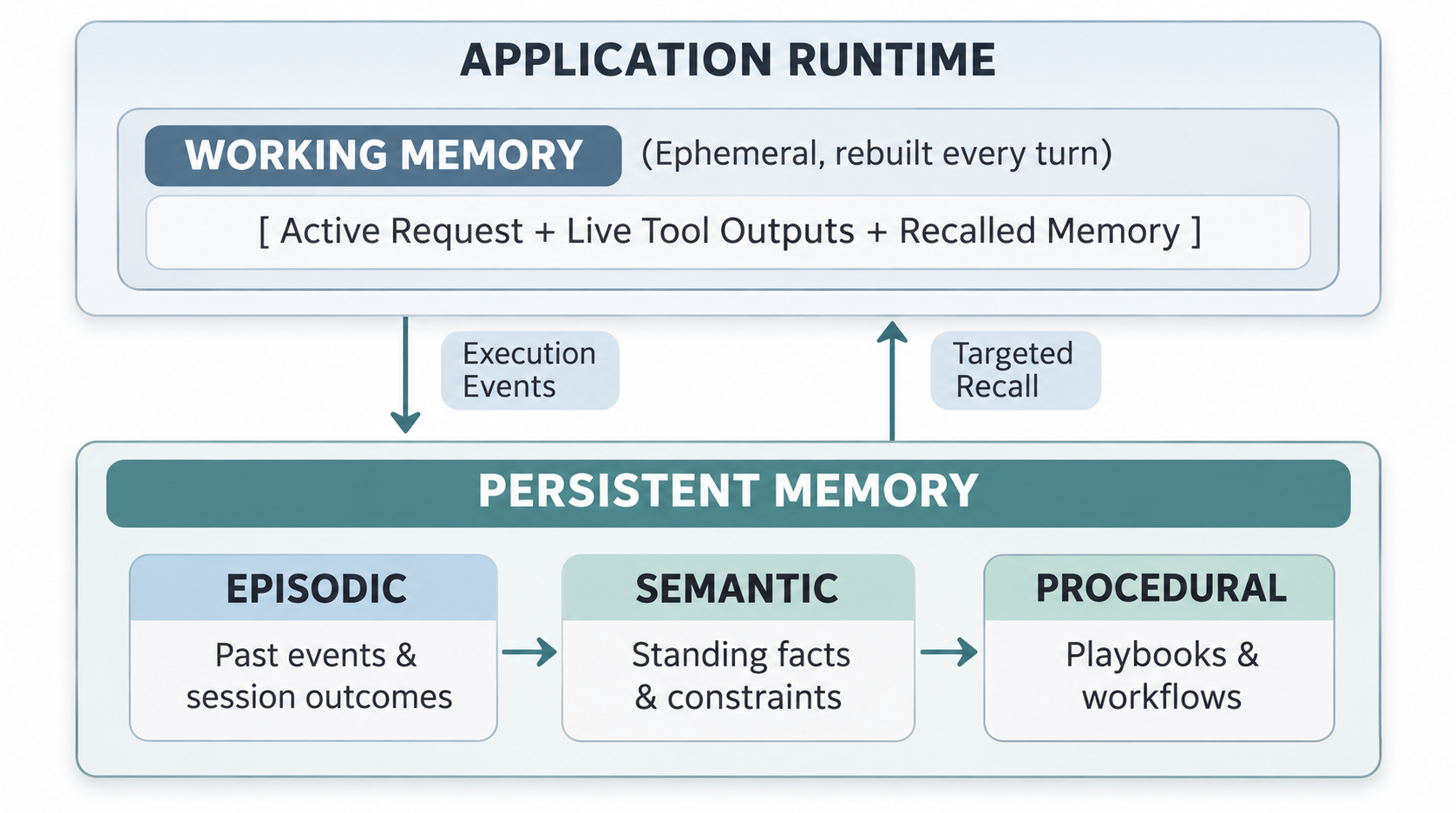
Each type serves a different purpose:
- Episodic Memory (What happened): Concrete records of past activities, observations, and outcomes across sessions.
- Semantic Memory (What we know): Standing facts, rules, preferences, and constraints that remain true beyond a single episode.
- Procedural Memory (How we do things): Reusable operational playbooks, workflows, and verification checklists for handling a class of tasks.
- Working Memory (What matters right now): The compact, token-bounded context assembled for a single model call, combining the active user request, live tool outputs, and recalled long-term memories.
The three persistent types don’t all come from the same place. Episodes and semantic facts are usually extracted from live runtime events, while procedures are often written or curated by engineers. Working memory exists only for a single turn and is rebuilt from scratch on the next.
Here’s how the four memory types apply to the CostGuard example:
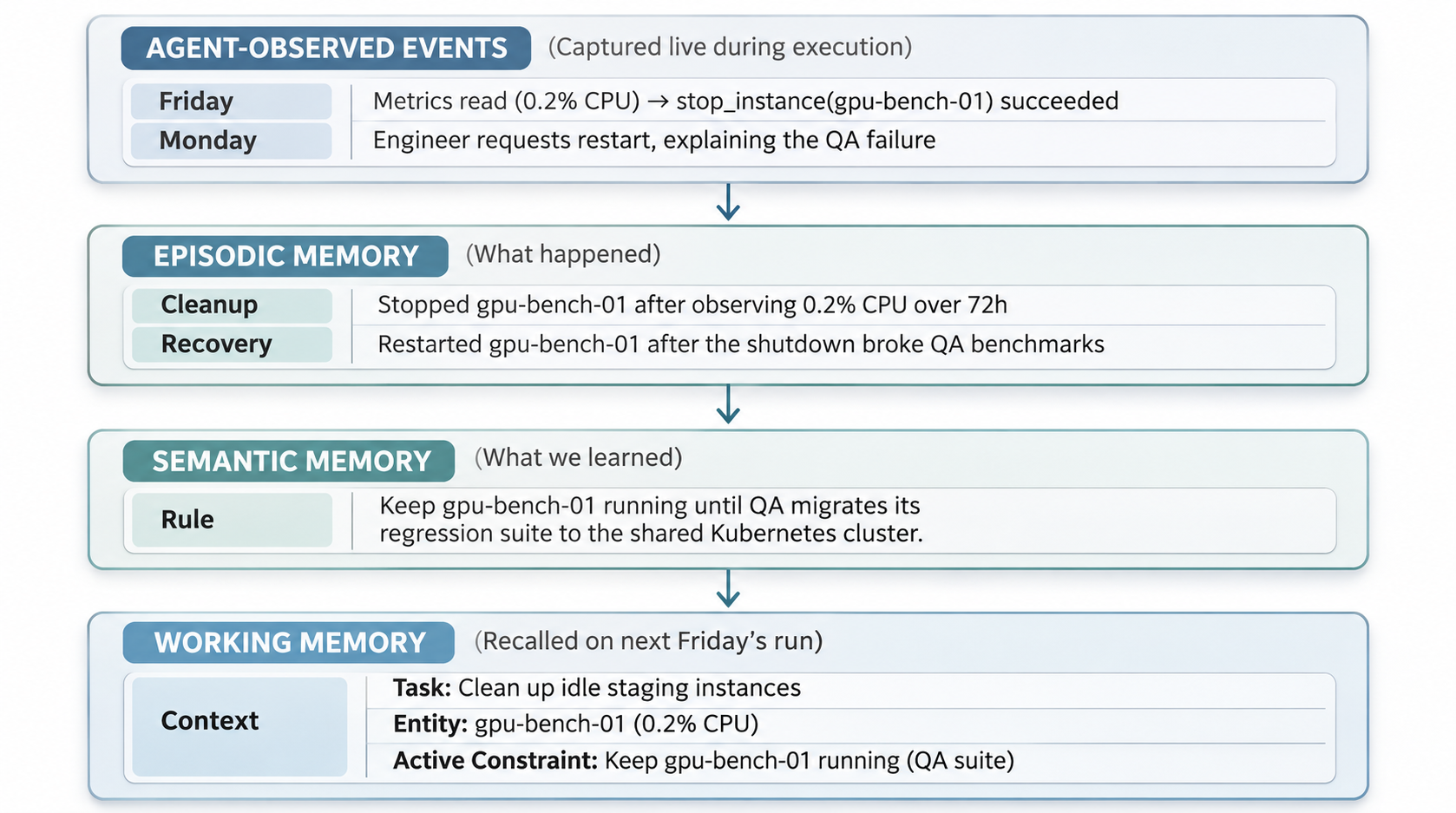
Writing Memories
Every time an agent runs a tool, receives an error, completes a task, or gets human feedback, it generates an execution event. Capturing those events is cheap; turning them into clean, trustworthy memories takes more work. An event-driven pipeline handles that processing asynchronously, keeping it out of the agent’s execution path.
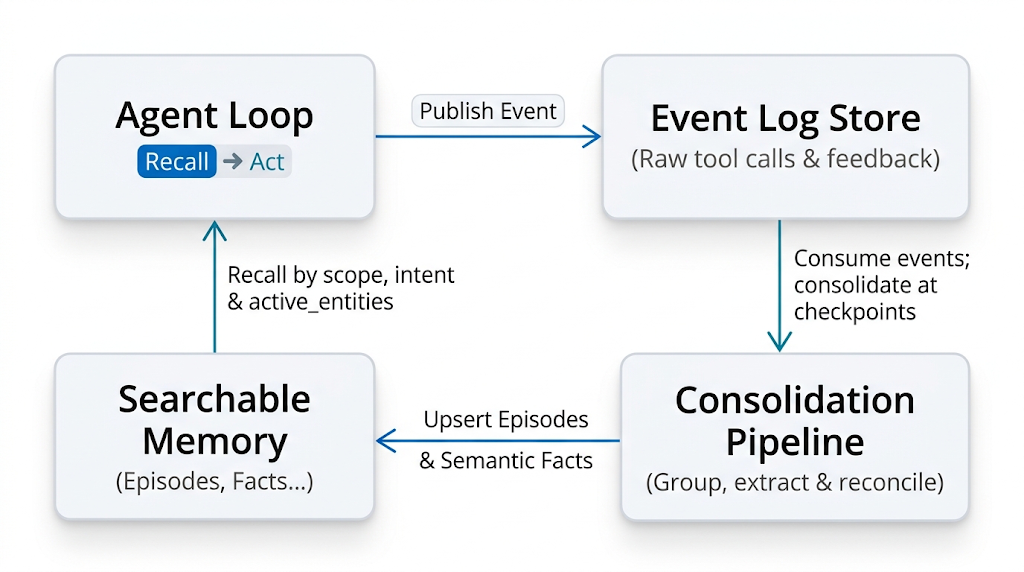
During the active turn loop, the runtime publishes structured events to an append-only log as tools finish and users respond. Because event publishing involves no LLM calls, it adds minimal overhead to the agent’s execution.
Memory consolidation happens in the background via a worker or stream consumer. Rather than calling an LLM after every single tool execution, the worker waits for meaningful checkpoints, such as a completed task, a verification failure, or explicit user feedback. When a checkpoint fires, the worker inspects the grouped events, builds or updates an episode if the activity is worth keeping, and extracts any new semantic facts to reconcile against the existing ones.
Reading Memories in the Turn Loop
On the read side, the runtime retrieves relevant memories before deciding what to do next. Recall happens throughout the task as new resources and observations become available:
def agent_step(task, context):
    memories = recall(task, entities=context.active_entities)

    action = model.next_action(task, context, memories)
    result = execute(action)

    publish_event(action, result)

    return result
This step repeats throughout the cleanup. The initial request only describes the high-level task, so the first recall pass pulls general workflow context. Once the agent lists the staging instances, however, the next iteration has concrete resource identifiers to search for, which surfaces any resource-specific restrictions before the agent decides what to shut down. Meanwhile, events from the current execution are recorded without waiting for background extraction to finish.
3. Episodic Memory: What Happened
An episode captures a specific experience with enough context to make it useful later. Sometimes that is a single interaction, such as a customer reporting a service outage. Other times, the experience unfolds across several tool calls, decisions, or even sessions.
Episode boundaries depend on the application. A coding assistant might remember a failed test and the fix that worked, while a support agent retains an unresolved customer issue. For an operational agent, an episode might capture a cleanup attempt involving several observations and state-changing actions.
Consider the initial cleanup. CostGuard inspects gpu-bench-01, sees almost no CPU activity over the last three days,
and shuts it down.
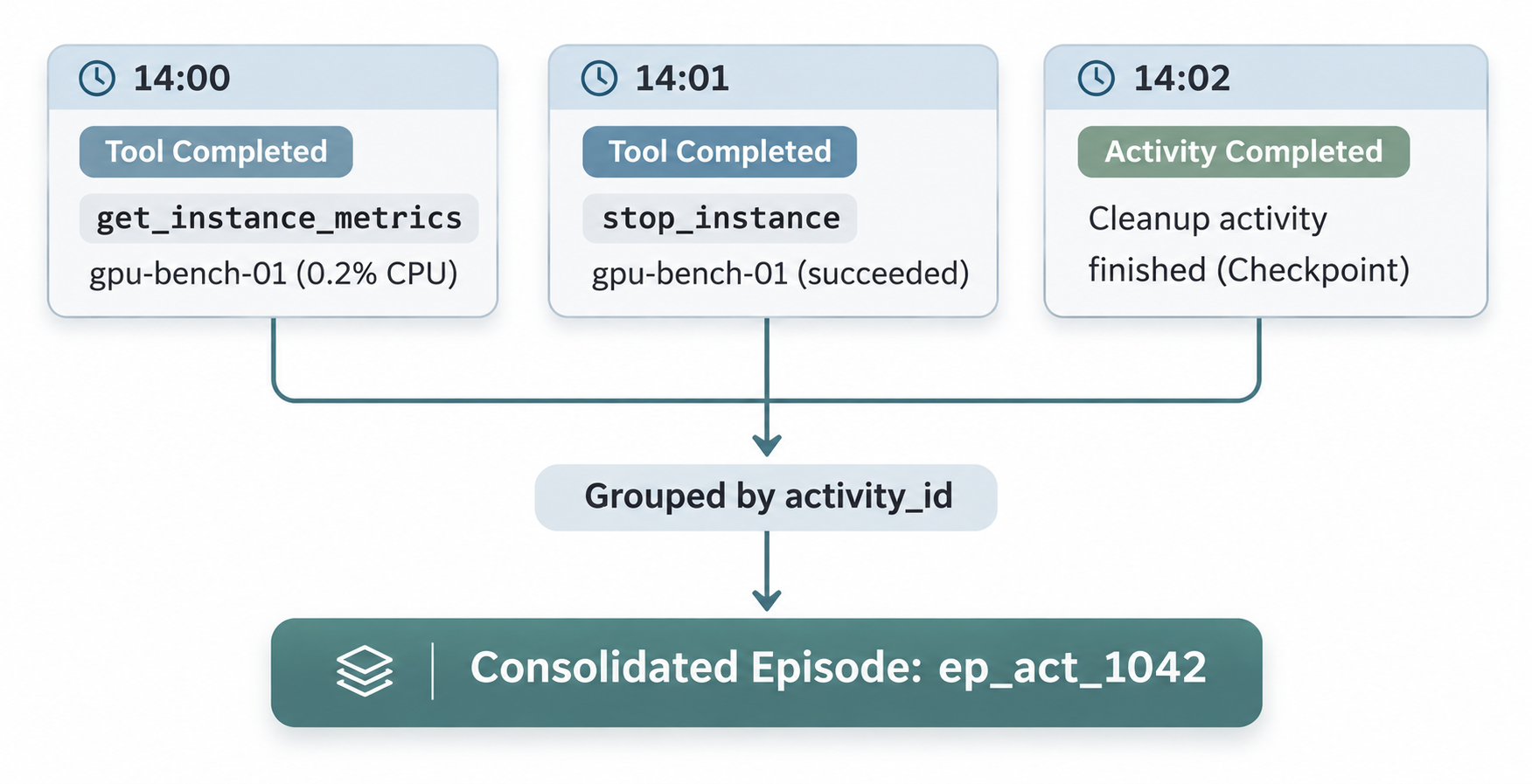
Instead of writing a single summary at the end of a chat session, the runtime records events as they happen and groups related steps asynchronously into an episode. That preserves what the agent actually did and observed during the operation, even when downstream consequences only become clear in a later session.
Events vs. Episodes
Separating raw runtime events from consolidated episodes gives each record a clear job and a lean, domain-agnostic schema.
A Runtime Event is a single, point-in-time record written when something happens: a tool completes, a user sends a message, or an activity finishes. Events are append-only and fast to write. We don’t inject raw events straight into future prompts because a single task might generate dozens of intermediate observations and retries.
| Field | Purpose |
|---|---|
event_id, timestamp | Identify the event and when it happened |
activity_id | Groups events belonging to the same activity or execution attempt |
event_type | What happened, such as tool.completed, activity.completed, or user.message |
scope | Tenant, workspace, or other access boundary |
entities | Stable identifiers of resources or records involved |
actor | Agent, user, or component responsible for the event |
evidence_ref | Reference to the original trace, message, or tool result |
data | Event-specific payload, such as tool arguments, results, or the user’s message |
An Episode is a compact, searchable record of a meaningful experience. Built from related events, it captures what happened, the observed execution status, and how the activity was resolved, if known.
| Field | Purpose |
|---|---|
episode_id | Unique identifier of the recorded experience |
scope | Access and retrieval boundaries |
entities | Resources or records involved, indexed for later retrieval |
status | Observed execution status, such as completed, failed, or unresolved |
summary | Short description of what happened and what was observed |
resolution | Optional explanation of how the experience was resolved |
sources | References to the underlying events or supporting evidence |
created_at, updated_at | When the episode was created and last updated |
All events from the same operation share an activity_id. Inspecting and stopping gpu-bench-01 belong to one
activity, for example, while a later recovery attempt receives another. The consolidated episode keeps the context
needed for recall without replaying the entire execution trace, and its sources field points back to the underlying
evidence when more detail is needed.
Consolidating Events into Episodes
Because the background processor waits for checkpoints rather than summarizing every event as it arrives, it can evaluate an operation as a whole. A completed activity is an obvious checkpoint; others include a failed operation, a user correction, or a long-running task reaching an intermediate milestone. An unfinished debugging session, for example, may still contain useful context even without a final outcome.
A checkpoint triggers evaluation, but doesn’t guarantee that a new episode will be created. Routine read-only checks can be skipped or kept merely as supporting evidence for a larger experience.
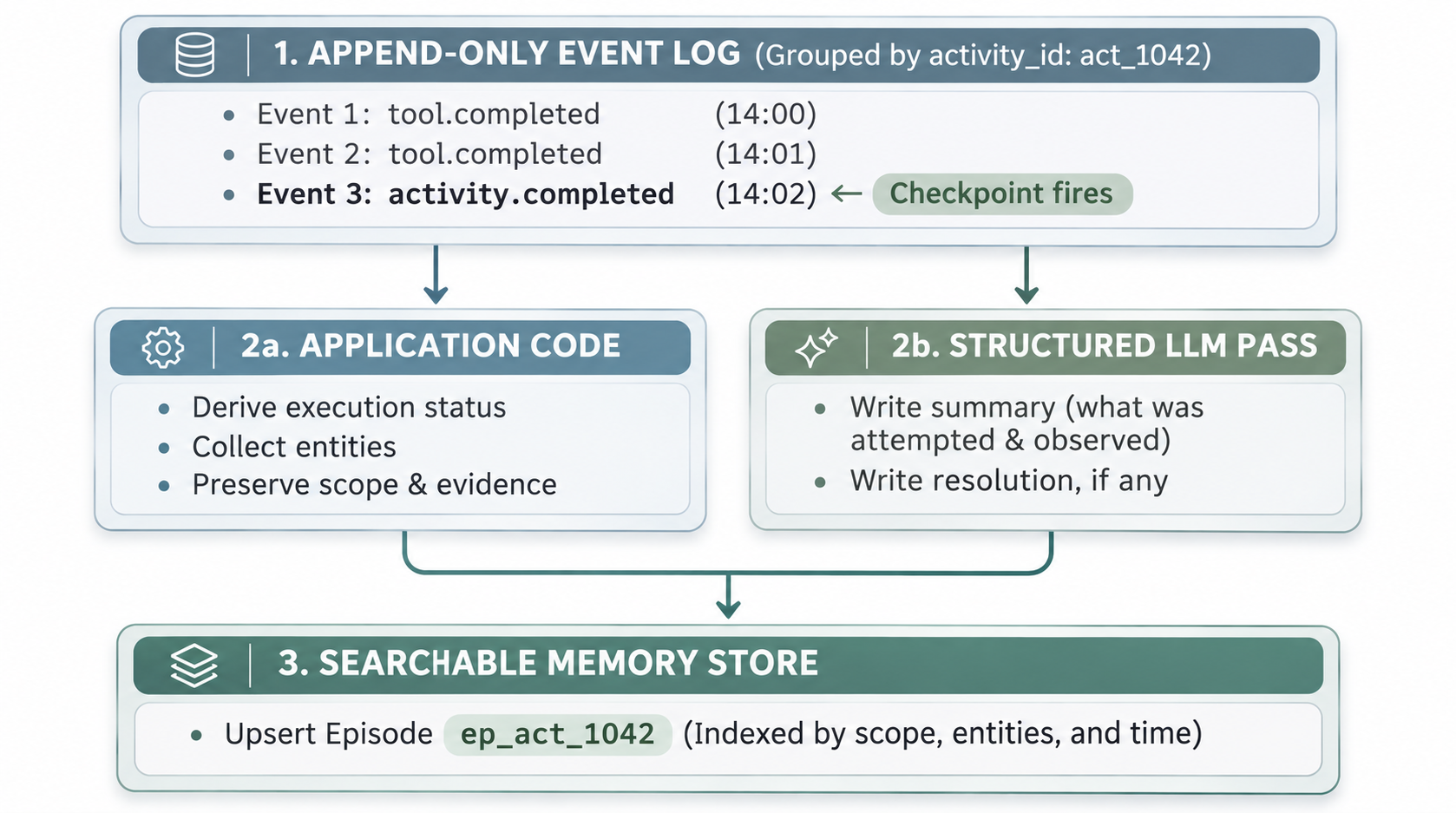
For events that pass this filter, the worker splits the job between application code and the language model. Application code derives the execution status, merges entity identifiers, and collects evidence references directly from the recorded events rather than relying on an LLM’s interpretation of them. The LLM handles the narrative: a short description of what happened and, when available, how the experience was resolved. For simple interactions, the original event content may already be sufficient without a model pass.
Building an Episode for CostGuard
As the agent inspects and stops the instance, the runtime captures three events without relying on the model to call a
save_memory() tool:
# CostGuard inspects gpu-bench-01
publish_event(
    activity_id="act_1042",
    event_type="tool.completed",
    entities=["cloud-instance:i-09a8f"],
    evidence_ref="trace://act_1042/metrics",
    data={
        "tool": "get_instance_metrics",
        "resource": "gpu-bench-01",
        "avg_cpu_pct": 0.2,
        "window_hours": 72,
    },
)

# CostGuard stops the instance
publish_event(
    activity_id="act_1042",
    event_type="tool.completed",
    entities=["cloud-instance:i-09a8f"],
    evidence_ref="trace://act_1042/stop",
    data={"tool": "stop_instance", "status": "succeeded"},
)

# Resource cleanup finishes, triggering a checkpoint
publish_event(
    activity_id="act_1042",
    event_type="activity.completed",
    entities=["cloud-instance:i-09a8f"],
    evidence_ref="trace://act_1042/completion",
    data={"status": "completed"},
)
The runtime attaches the remaining fields (event id, timestamp, actor, and scope) and records the stable cloud resource
identifier (cloud-instance:i-09a8f) alongside its display name.
When the checkpoint triggers build_episode(), the background worker combines code-derived metadata with the
LLM-generated summary:
class EpisodeNarrative(BaseModel):
    summary: str
    resolution: str | None = None


def build_episode(scope: dict, activity_id: str):
    events = event_log.get_events(
        scope=scope,
        activity_id=activity_id,
    )

    if not should_keep_episode(events):
        return None

    # Compute metadata from the recorded events
    status = derive_execution_status(events)
    entities = collect_unique_entities(events)
    sources = collect_evidence_refs(events)

    # Summarize what happened
    narrative = llm.extract_structured(
        schema=EpisodeNarrative,
        context=select_relevant_evidence(events),
    )

    episode = {
        "episode_id": f"ep_{activity_id}",
        "scope": scope,
        "entities": entities,
        "status": status,
        "summary": narrative.summary,
        "resolution": narrative.resolution,
        "sources": sources,
    }

    return memory_store.upsert_episode(episode)
The memory store manages creation and update timestamps during persistence, producing this record:
{
  "episode_id": "ep_act_1042",
  "scope": {"workspace": "staging-cloud"},
  "entities": ["cloud-instance:i-09a8f"],
  "status": "completed",
  "summary": "Stopped gpu-bench-01 after observing 0.2% average CPU utilization over the preceding 72 hours.",
  "resolution": null,
  "sources": [
    "trace://act_1042/metrics",
    "trace://act_1042/stop",
    "trace://act_1042/completion"
  ],
  "created_at": "2026-10-30T14:02:00Z",
  "updated_at": "2026-10-30T14:02:00Z"
}
The status field is completed, not correct or safe. When the cleanup finishes, the API call has succeeded and
the QA benchmark hasn’t failed yet. The episode records the execution as the agent observed it at the time. When the
engineer later steps in to restart the server and explain what broke, that feedback produces a separate recovery
episode. It also gives the consolidation worker something more durable to extract: a standing operational rule.
4. Semantic Memory: Facts That Outlive a Session
The engineer’s correction explains the earlier failure, and it also establishes knowledge that CostGuard must apply
long after the recovery session ends: QA depends on the instance, and it needs to stay running until the regression
suite moves to Kubernetes.
As an agent accumulates experience, relying on episodic history alone becomes impractical. You don’t want it digging through a dozen past incident summaries every time it needs to determine which restrictions currently apply to a resource. Semantic facts give the agent direct access to reusable knowledge (operational rules, user preferences, service dependencies), while episodes preserve the history and evidence behind them.
Anatomy of a Semantic Fact
Many operational facts are conditional or temporary: an instance exemption lasts until a workload migrates, a billing hold until an invoice clears, a release freeze until a hotfix ships. To track them without losing sight of when they expire or who established them, each semantic fact stores a small set of structured fields:
| Field | Purpose |
|---|---|
fact_id | Unique identifier for the fact |
scope | Workspace, tenant, or other boundary where the fact applies |
entity | Stable identifier of the resource or subject |
attribute | Property or policy being described, such as lifecycle_policy |
value | The rule or assertion itself |
ends_when | Optional condition under which the fact stops applying |
status | Whether the fact is current, unverified, superseded, or retired |
authority_role, source | Authenticated role of the source actor and reference to the supporting evidence |
The engineer’s instruction doesn’t expire on a fixed date. It expires on an operational condition, and that condition must be verified before the restriction can be retired. The passage of time or another stretch of low utilization isn’t enough.
Extracting Facts and Checking Authority
Fact extraction runs in the same background consolidation worker that builds episodes. When the recovery activity reaches a checkpoint, the worker records the recovery episode and inspects the engineer’s feedback for durable facts worth carrying into future sessions.
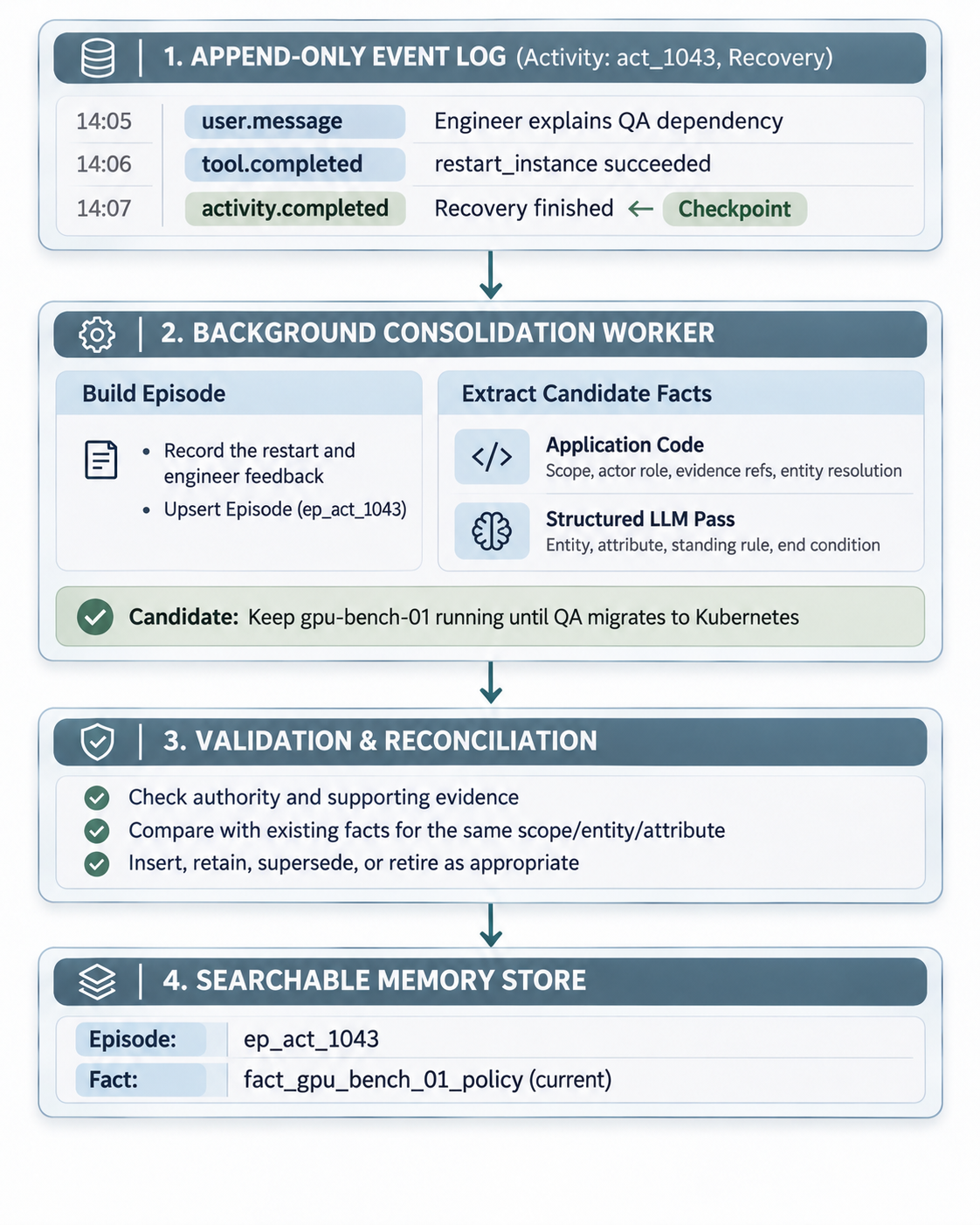
In this example, the engineer’s message is the source of the new fact. Other agents might extract reusable knowledge from tool results, task outcomes, or external observations. The extraction process follows the same pattern:
class ExtractedFact(BaseModel):
    entity: str
    attribute: str
    value: str
    ends_when: str | None = None
    event_ids: list[str]  # events this fact is based on

class CandidateFacts(BaseModel):
    facts: list[ExtractedFact]


def extract_candidate_facts(events, episode):
    extracted = llm.extract_structured(
        schema=CandidateFacts,
        context={
            "events": select(events),
            "known_entities": episode["entities"],
        },
    )

    candidates = []
    for fact in extracted.facts:
        cited = [e for e in events if e.event_id in fact.event_ids]
        entity = resolve_entity(fact.entity, episode["entities"])
        if not cited or entity is None or not grounded_in_events(fact, cited):
            continue

        candidates.append({
            "scope": episode["scope"],
            "entity": entity,
            "attribute": normalize_attribute(fact.attribute),
            "value": fact.value,
            "ends_when": fact.ends_when,
            "authority_role": lowest_authority(cited),
            "source": [e.evidence_ref for e in cited],
        })

    return candidates
The entity resolution step maps resource names mentioned in conversation to the stable identifiers already observed by the agent, so later retrieval doesn’t depend on matching the exact wording an engineer used.
Extracting a plausible instruction doesn’t automatically make it an active fact, however. The runtime still checks
whether the actor is allowed to establish that fact in the target scope. In a personal assistant, an end user can set
their own meeting preferences; in a shared infrastructure workspace like staging-cloud, changing a server’s lifecycle
policy requires an authorized engineering role. Once that role is verified from authenticated runtime metadata, the
instruction becomes a current fact, while the earlier shutdown episode stays intact as historical evidence.
The Partial Evidence Trap
Suppose an engineer requests another staging cost review midweek. The agent queries the cloud provider and finds that
gpu-bench-01 has remained at 0% utilization for the past 48 hours. During the same interaction, a developer comments,
“Looks like gpu-bench-01 isn’t being used anymore. We can probably shut it down.”
Both observations are captured through normal runtime events, yet neither proves that the standing restriction has expired. Low utilization midweek is consistent with a machine reserved for weekend benchmarks, and the developer’s remark is speculative, offering no evidence that QA has migrated its workload.
A memory system that continually asks an LLM to rewrite a rolling entity summary, or blindly overwrites stored facts with the latest observation, will easily mistake these signals for proof that the restriction is obsolete. Suppose the memory record shifts from “Keep this instance running for weekend QA benchmarks” to “Instance has been idle for 48 hours; developer suggests shutting it down.” Both statements reflect something the agent observed, but the second carries a different level of authority and doesn’t invalidate the first. Replacing the old fact with the latest observation wipes out the instruction that matters.
Reconciling New Evidence with Existing Facts
Before accepting a new candidate fact, the consolidation worker looks for a current fact with the same scope, canonical
entity identifier, and attribute. With none, an authorized statement becomes current and an unauthorized claim is
recorded as unverified. With one, the worker compares the incoming signal against it:
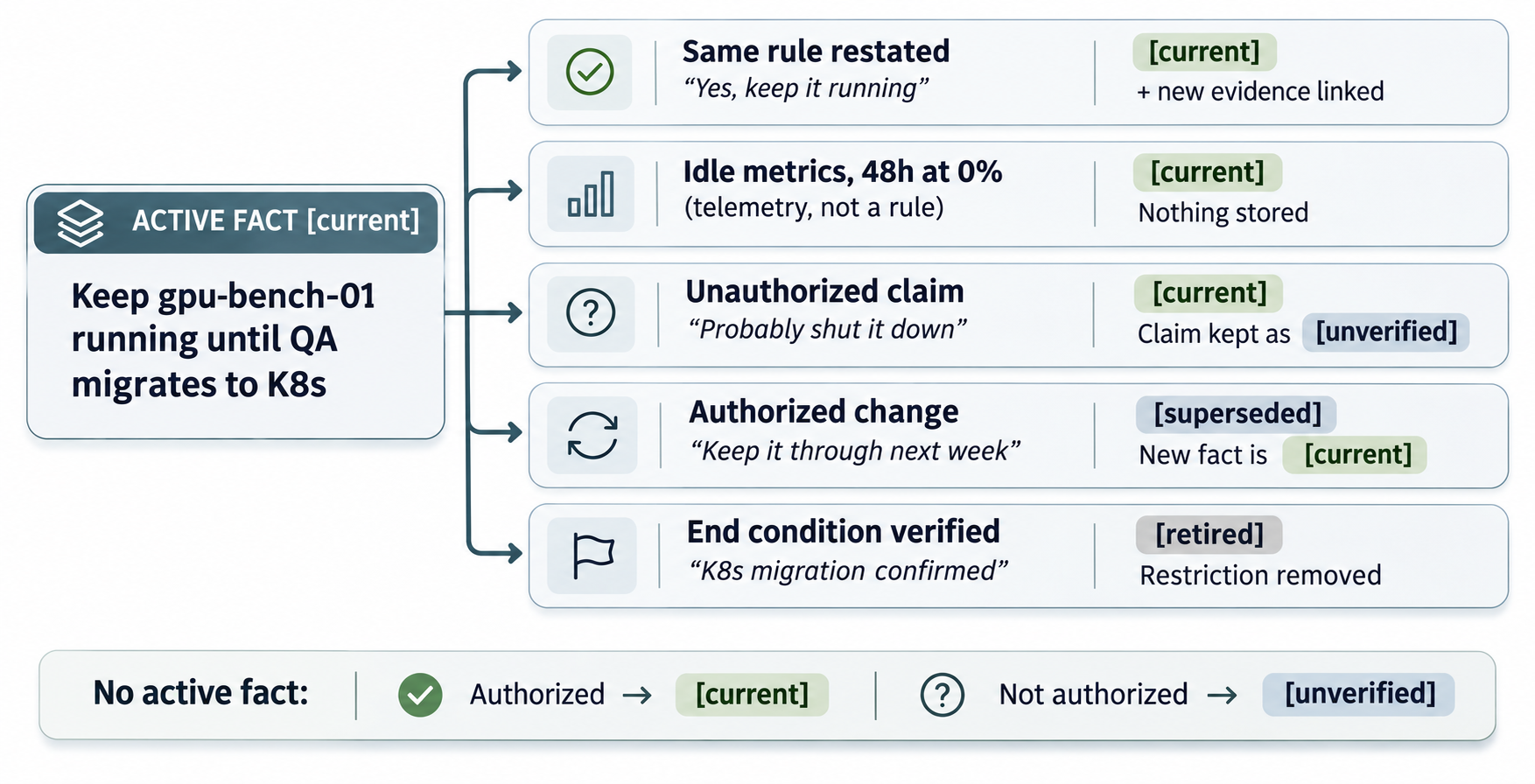
The first three branches leave the current fact untouched. A restatement just adds its evidence to the existing fact.
Idle metrics are ignored: they describe the instance’s state rather than a rule, and the event log and cloud APIs already
hold that data. An unauthorized comment like “Probably shut it down” is recorded as unverified, so casual chat can’t
silently override an approved restriction.
The other two branches change the fact and need an authoritative source. Suppose the infrastructure lead says, “QA has
changed its plans. Keep the instance reserved through next week’s final benchmark instead of waiting for the Kubernetes
migration.” The lead can modify lifecycle policies, so the old fact becomes superseded and the new one becomes current
with its own source, even though the original migration condition wasn’t met.
A fact also ends when its ends_when condition is met, but conditions aren’t self-verifying. The runtime waits for
confirmation from an authorized operator or an authoritative system before marking the fact retired. That lifts the
exemption without forcing a shutdown: the standard cleanup policy applies again. Superseded and retired facts stay in the
store as an audit trail but are excluded from active retrieval.
In the midweek scenario, neither the idle metrics nor the developer’s comment has the authority to change the restriction, so the active semantic fact remains unchanged:
{
  "fact_id": "fact_gpu_bench_01_policy",
  "scope": {
    "workspace": "staging-cloud"
  },
  "entity": "cloud-instance:i-09a8f",
  "attribute": "lifecycle_policy",
  "value": "Keep gpu-bench-01 running for Friday-night QA regression tests",
  "ends_when": "QA regression suite migrated to shared Kubernetes cluster",
  "status": "current",
  "authority_role": "infra_lead",
  "source": "trace://act_1043/message"
}
When the agent encounters the instance during its next cleanup sweep, that constraint now needs to find its way back into the agent’s context before it acts on the instance.
5. Recall: The Right Memory at the Right Step
Retrieval is where many memory architectures fall apart. It is easy to assume that when a session starts, the runtime already has metadata naming the exact workflow, target environment, and affected resources.
In a production agent, you rarely have that at request time. When a user sends a message or a webhook triggers a run, the runtime initially knows only three things:
- Caller & Agent Identity: From authentication and the session entry point, the runtime knows who is calling
(
user_id,org_id, roles) and which agent is running (agent_id). These identities establish the authorized storage scope, ensuring memories from one tenant or workspace aren’t exposed to another. - The Raw Prompt: A short, often vague request from the user, such as “Run the weekly staging cost cleanup”, “Why is my refund still pending?”, or “Fix the flaky auth test.”
- Live Conversation State: Whatever messages or tool outputs have accumulated in the current session so far, which is empty on Turn 1.
What the runtime doesn’t know yet is which servers are idle (gpu-bench-01), which refund transaction failed
(tx_992), or which file contains the flaky test. Those entities only surface after the agent starts running tools.
Progressive Recall
Because the agent discovers what it is working on step by step, memory retrieval cannot be a single search executed once
before Turn 1. Instead, recall() runs at the start of every turn, using a turn_context that gets richer as the agent
interacts with the environment:
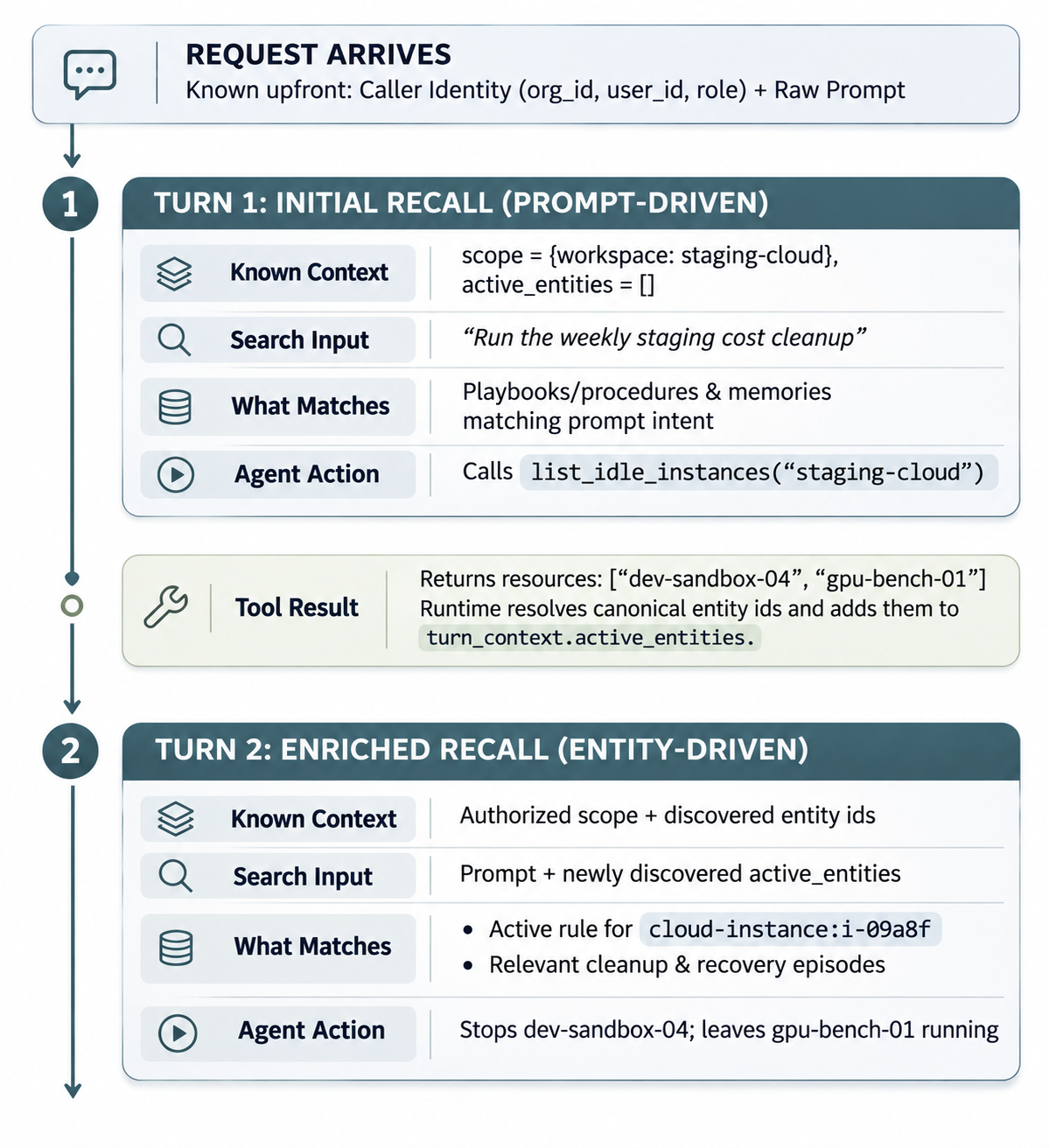
Here is how the runtime updates context after each tool execution so the next turn can query against newly
discovered resources:
def update_context(context, action, tool_result):
    # 1. Keep the live tool observation for the current prompt window
    context.live_observations.append(tool_result.summary)

    # 2. Extract entity ids from structured tool args/outputs (e.g. resource ids, service names)
    discovered_ids = extract_entity_ids(action.args, tool_result.structured_data)
    for entity_id in discovered_ids:
        if entity_id not in context.active_entities:
            context.active_entities.append(entity_id)
Why Vector Search Alone Isn’t Enough
With the authorized scope, request text, and discovered entities in hand, how should the runtime search the memory store?
Relying purely on vector embeddings creates three blind spots in production:
- Embeddings blur exact identifiers. Dense vectors are great at matching fuzzy concepts (“cut cloud spend”
≈ “cost cleanup”), but they frequently miss exact resource names, error codes, or environment tags like
gpu-bench-01,staging-cloud, orERR_RATE_LIMIT. - Similarity ignores validity. A fact that was superseded three weeks ago has the exact same cosine similarity to a query as the fact that replaced it today.
- Similarity doesn’t reflect operational priority. A loosely related incident might score higher than an active restriction that must be considered before taking action. Retrieval has to weigh applicability and importance as well as semantic relevance.
Memory engines and hybrid search systems address these problems by combining metadata pre-filtering with complementary search signals: semantic vector search, keyword matching (BM25), and exact entity lookup.
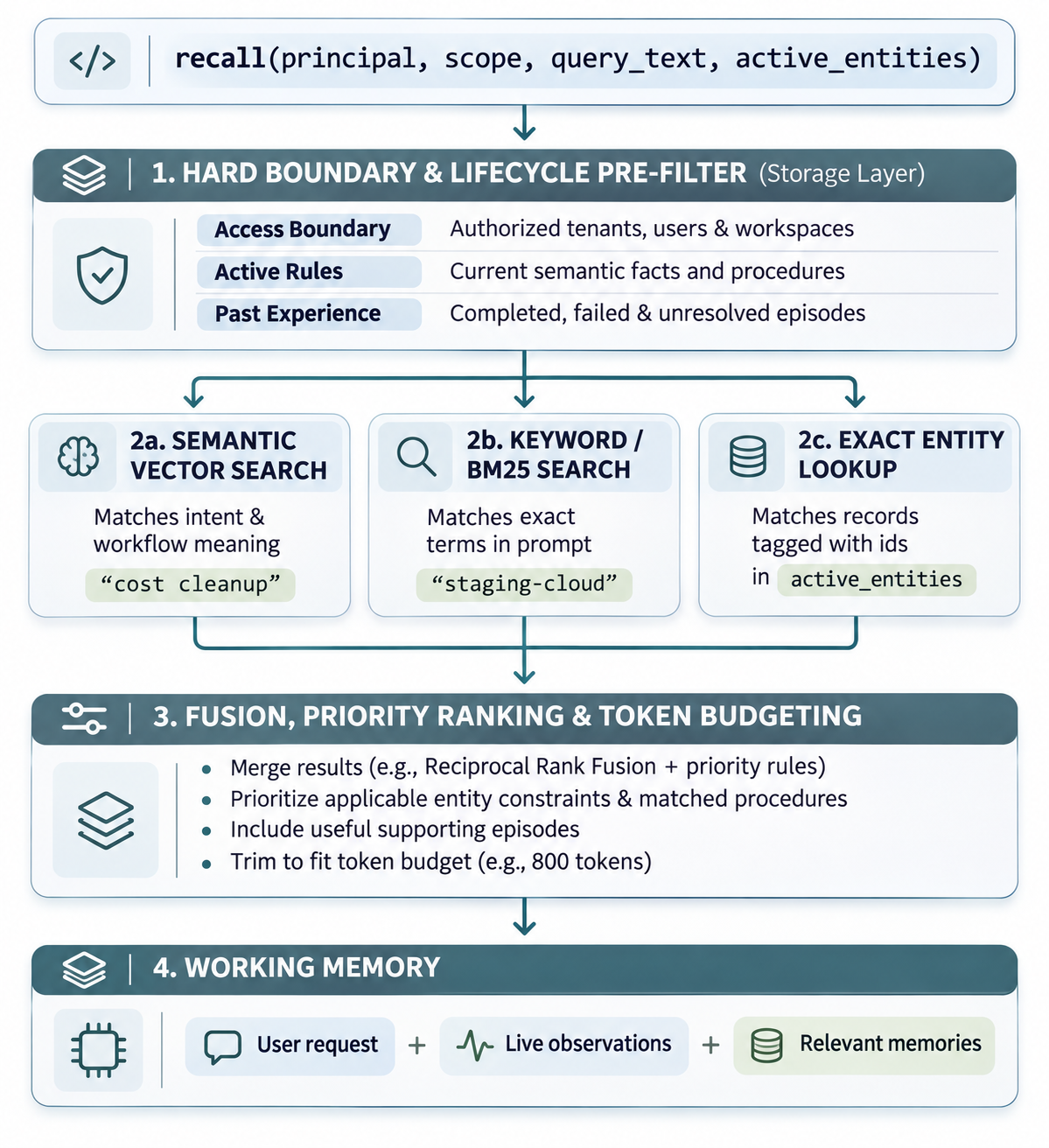
Hard pre-filtering restricts retrieval to memories the caller is authorized to access and prevents superseded or unverified facts from showing up as active instructions. Episodes are filtered differently: a completed activity still holds useful history even when its outcome later required a rollback.
Within that authorized slice, vector search matches the intent of the request, BM25 catches exact terms like environment
tags and error codes, and exact entity lookup pulls facts and episodes indexed under the canonical resource ids
in active_entities. The results are then deduplicated and ranked, giving applicable entity constraints priority over
supporting history. Token budgeting should trim lower-priority memories first, without silently dropping restrictions
that may govern the next action. If those constraints cannot fit, the runtime needs to narrow the context or defer the
decision.
Hybrid Recall in Code
Here is how recall() brings those three search paths together in code:
def recall(
    principal: UserPrincipal,
    scope: dict,
    query_text: str,
    active_entities: list[str],
    token_budget: int = 800,
) -> list[dict]:
    # 1. Resolve authorized scopes
    allowed_scopes = resolve_authorized_scopes(principal, requested_scope=scope)

    # 2. Vector + BM25 search, filtered by memory type and state
    text_matches = memory_store.hybrid_search(
        query_text=query_text,
        scopes=allowed_scopes,
        pre_filter={
            "fact": ["current"],
            "procedure": ["active"],
            "episode": ["completed", "failed", "unresolved"],
        },
        top_k=10,
    )

    # 3. Exact lookup, skipped on Turn 1 when no entities are known yet
    entity_facts, entity_episodes = [], []
    if active_entities:
        entity_facts = memory_store.find_facts(
            scopes=allowed_scopes,
            entities=active_entities,
            status="current",
            limit=20,
        )
        entity_episodes = memory_store.find_episodes(
            scopes=allowed_scopes,
            entities=active_entities,
            status=["completed", "failed", "unresolved"],
            order_by="recent",
            limit=5,
        )

    # 4. Merge, prioritize and fit into the context budget
    candidates = merge_and_deduplicate(
        text_matches, entity_facts, entity_episodes,
    )

    ranked = rank_memories(
        candidates,
        prioritize_entity_constraints=True,
    )

    return pack_into_token_budget(
        ranked,
        max_tokens=token_budget,
    )
Entity-specific recall has to happen after resource discovery but before the agent decides what to do with those resources. That timing lets a constraint established in an earlier session influence the current decision, even when the original request never mentioned the affected resource.
6. Working Memory and Playbooks: What the Model Sees
Once recall returns the relevant memories, the runtime still needs to combine them with the current task and live execution context before calling the model. This assembled view is the agent’s working memory: the information available to it when making its next decision.
Assembling Working Memory
When building the prompt view for a turn, the runtime pulls from three sources:
- Live Observations: Outputs from tools executed during the current session, such as CPU utilization or resource status.
- Retrieved Long-Term Memories: The ranked semantic facts, past episodes, and procedures returned by
recall(). - Recent Session Context: User messages and other events from the active session that haven’t yet been consolidated into long-term memory.
Recent session context bridges the delay introduced by asynchronous consolidation. If a user corrects the agent and immediately continues the conversation, that message can influence the next decision without waiting for a semantic fact to be extracted. This covers continuity within the active session; a new session started before consolidation finishes may still miss the correction. For critical updates, the runtime may need to read recent events directly or persist the constraint synchronously.
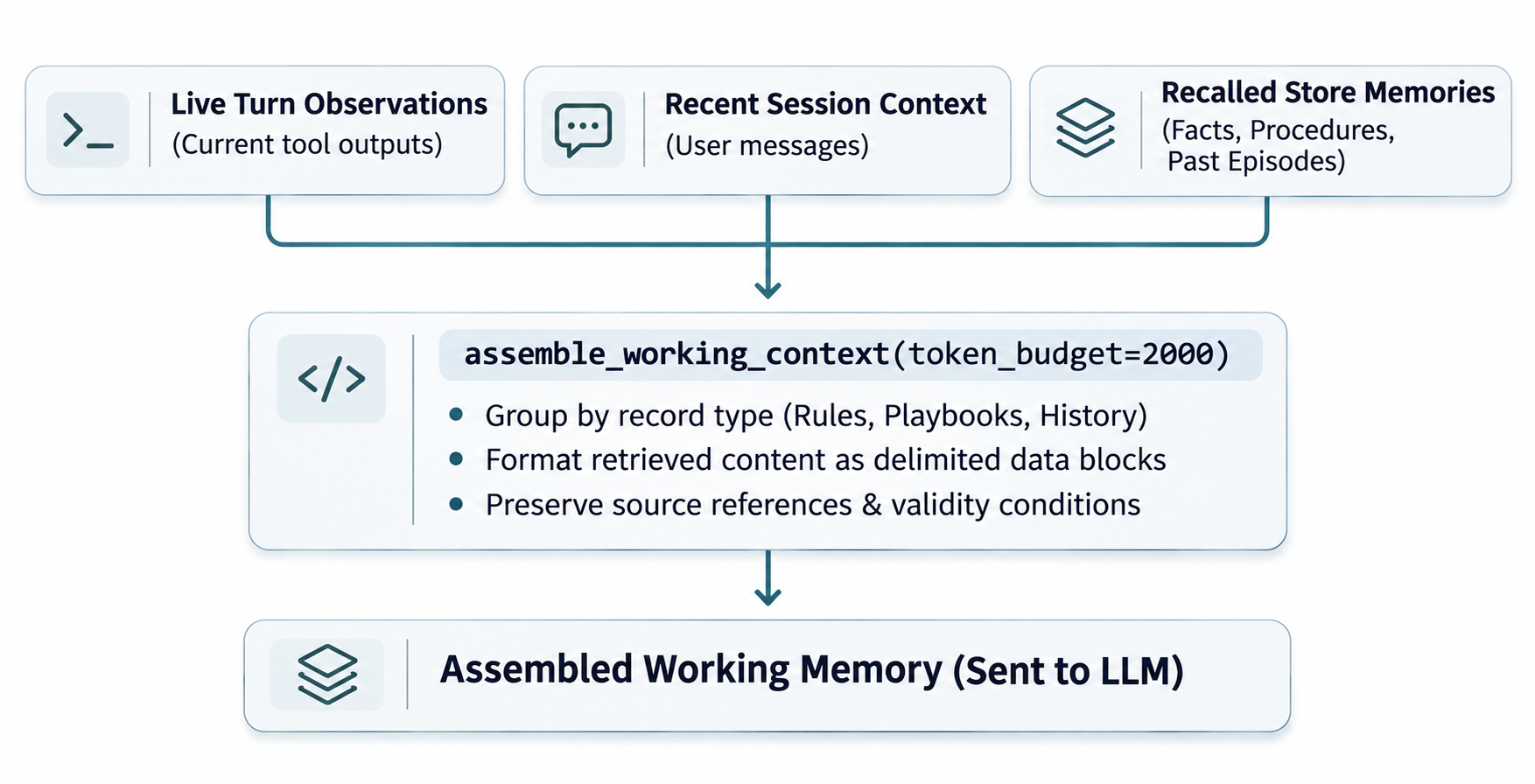
Here is how the runtime builds that view in code:
def assemble_working_context(
    task: Task,
    observations: list[str],
    memories: list[dict],
    session_context: list[str],
    token_budget: int = 2000,
) -> str:
    # Group recalled memories by type
    facts = [m for m in memories if m["kind"] == "fact"]
    procedures = [m for m in memories if m["kind"] == "procedure"]
    episodes = [m for m in memories if m["kind"] == "episode"]

    # Assemble the context for the next model call
    sections = [
        render_task_block(task.message),
        render_procedures_block(procedures),
        render_facts_block(facts),
        render_episodes_block(episodes),
        render_recent_context_block(session_context),
        render_live_observations_block(observations),
    ]

    return fit_sections_to_budget(
        sections,
        max_tokens=token_budget,
    )
To see what the assembled context might look like, imagine a subsequent cleanup run after the revised playbook has been approved. The agent has discovered the staging instances and collected their current metrics. Its working memory now contains:
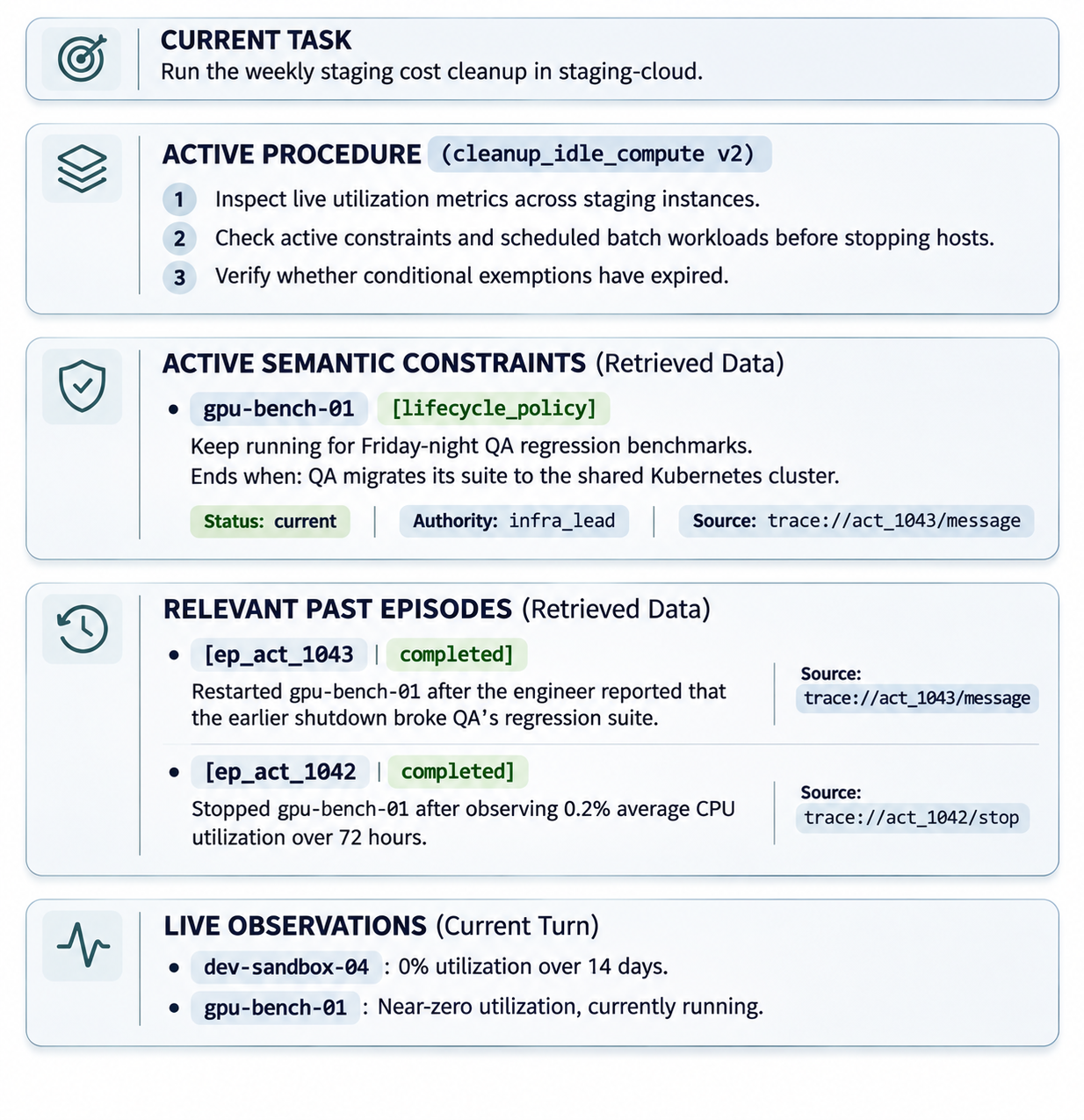
Instead of feeding the model an entire conversation transcript or replaying the raw event log, the runtime hands it a compact, task-specific view: live metrics describe the current resource state, the semantic fact carries the standing restriction, the episodes explain how that restriction came about, and the procedure lays out the workflow for evaluating each host.
Playbooks as Versioned Code
The ACTIVE PROCEDURE (cleanup_idle_compute v2) block in the assembled prompt comes from procedural memory. Episodes
track what happened during a specific attempt and semantic facts hold knowledge about particular resources, while
procedural memory captures how the agent should execute a class of tasks.
A procedure record stays simple and structured:
procedure_id,version: Identifier and version, such ascleanup_idle_computeandv2.scope: Where the playbook applies, from a shared agent workflow to a particular organization or environment.trigger_intent: Description of the task the procedure governs, indexed for retrieval.steps: Ordered instructions and verification checks the agent should follow.status,approved_by: Lifecycle state (current,draft, ordeprecated) and the owner who approved the procedure.
Procedures usually start as playbooks written by engineers. Over time, repeated episodes often expose a pattern that wasn’t obvious when the playbook was first drafted. If the original cleanup procedure only checked 48- or 72-hour CPU utilization before stopping an instance, repeated incidents with weekend batch jobs would reveal a workflow gap. That lesson shouldn’t stay buried inside individual server histories; it belongs in the cleanup playbook so future runs check batch schedules and active exemptions across every host.
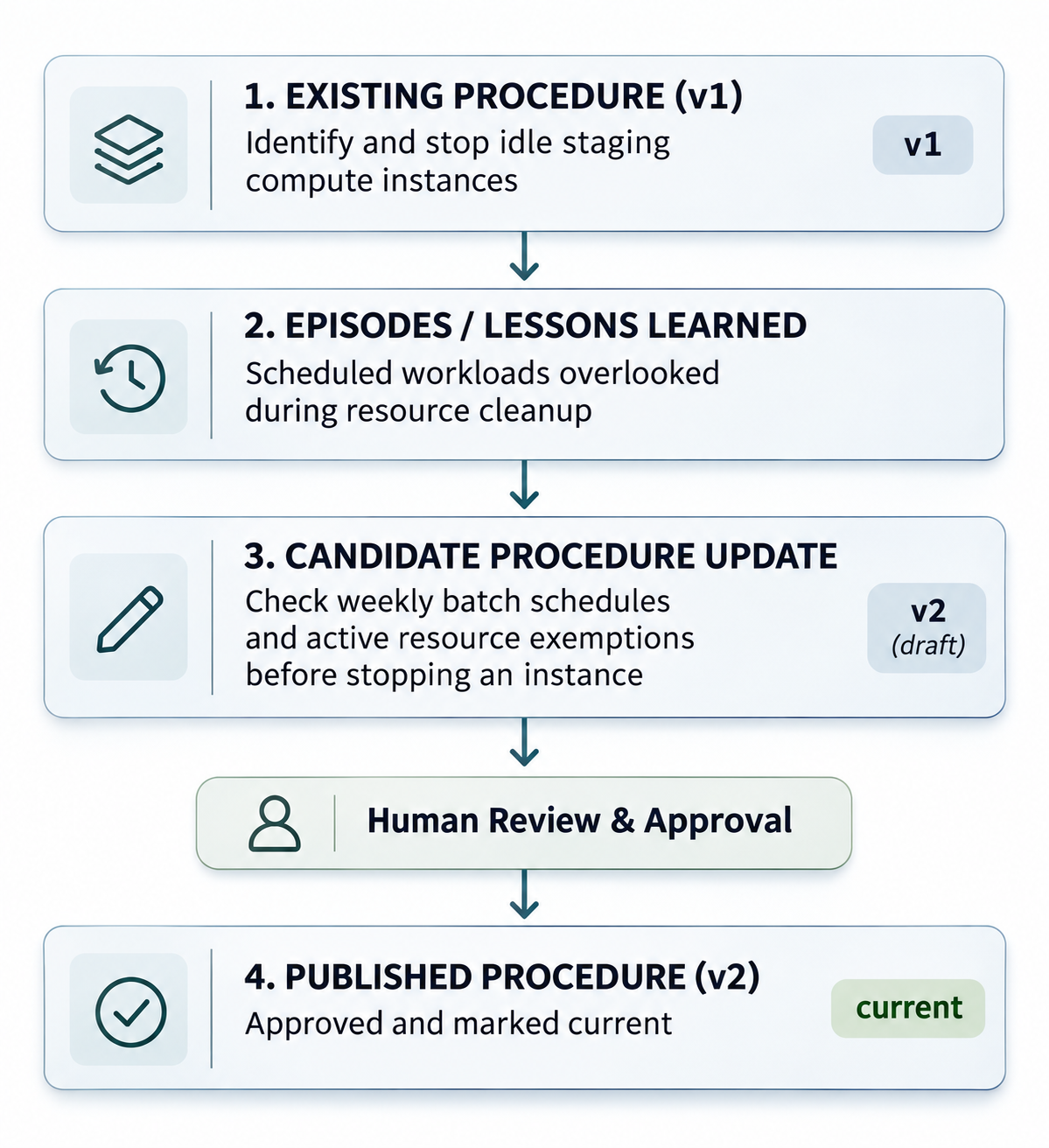
This is where procedural memory differs from ordinary fact extraction. A background worker can safely record a resource-specific constraint from authorized feedback, but automatically rewriting a shared operational playbook is a much bigger risk. If an LLM promotes a noisy workaround or a misunderstood ticket comment into a shared procedure, a mistake that originally affected one resource could suddenly influence every execution across hundreds of environments. Playbook updates should be proposed offline from recurring episodes, reviewed by humans, and versioned just like application code so you can roll them back if a new version causes problems.
The assembled context also labels semantic facts and episodes as (Retrieved Data). Stored memories often contain text
originally supplied by users, external tools, or ticket comments. Labeling recalled records as data rather than system
instructions helps defend against delayed prompt injection, while permissions, scope boundaries, and tool authorization
remain strictly enforced by the application runtime.
7. Did It Work? Judging Memory by Decisions
Equipped with the assembled working context, here is how CostGuard handles the next cleanup run:
“I found two idle instances in
staging-cloud.dev-sandbox-04has been idle for 14 days and has no active restrictions or scheduled workloads, so I’m stopping it. I’m leavinggpu-bench-01running despite its low utilization. The previous shutdown broke QA’s regression suite, and there’s still an active restriction protecting the instance until that workload moves to Kubernetes.”
Both instances look idle, but only one is safe to stop. You want to test that behavior, not just whether the memory system retrieved the right records.
Measuring Decisions, Not Search Scores
When teams evaluate agent memory, they often treat it like a standard search problem, measuring recall@k or cosine
similarity on static question-answering benchmarks. Benchmarks like LongMemEval are helpful for testing retrieval and
reasoning over long histories, but search scores alone won’t tell you whether your runtime prevents bad
production actions.
In production, the question is whether the agent can discover a resource mid-task, retrieve its active constraint, keep that constraint intact when irrelevant observations arrive, and let it go once its end condition is verified. Rather than testing isolated retrieval queries, build a small set of multi-session scenarios that test the agent’s end-to-end decisions:
| Test Scenario | Expected Behavior |
|---|---|
| Vague cleanup request | Discover the entity and retrieve its active restrictions |
| New idle metrics despite an active exemption | Preserve the restriction; don’t stop the instance |
| Unverified comment suggests shutdown | Don’t override an authorized instruction |
| Migration completion is verified | Retire the exemption; evaluate under the normal cleanup policy |
| Request crosses an access boundary | Never expose memories from unauthorized scopes |
Run the same scenarios against four configurations: no cross-session memory, raw-log RAG, episodic memory only, and the full pipeline with semantic facts and reconciliation. Keep the model, tools, and approved procedures consistent across configurations so improvements can be attributed to memory rather than changes elsewhere in the agent.
Alongside decision accuracy, track operational metrics that search benchmarks miss: how often the agent attempts a prohibited action, how often it incorrectly blocks a valid one, whether it relies on superseded information, and how much latency memory retrieval adds to each turn.
Start Simple, Add Layers
You do not need to build every piece of this architecture on day one. If your agent runs single-session tasks with a small set of tools, a clean event log and a versioned playbook file will get you surprisingly far.
As your agent takes on longer, multi-session workflows, you can roll out the architecture in four steps:
- Instrument the runtime loop: Capture structured execution events and human feedback, and trigger recall as new entities become available.
- Consolidate useful episodes: Group related events at meaningful checkpoints, preserving the outcomes and evidence worth recalling.
- Maintain semantic knowledge: Extract semantic facts, verify their authority, and reconcile new evidence against existing constraints.
- Evolve shared procedures: Use recurring lessons to propose playbook improvements, with human approval and version control.
There is no universal threshold where an agent suddenly needs all four memory layers. A personal assistant remembering user preferences has different requirements from an infrastructure agent modifying production resources. Start with the smallest memory layer that solves a real failure mode, and add structure as your agent’s responsibilities grow.
A useful memory system helps an agent distinguish what still matters from what has changed, apply that knowledge to the next decision, and trace its reasoning back to the evidence that informed it.